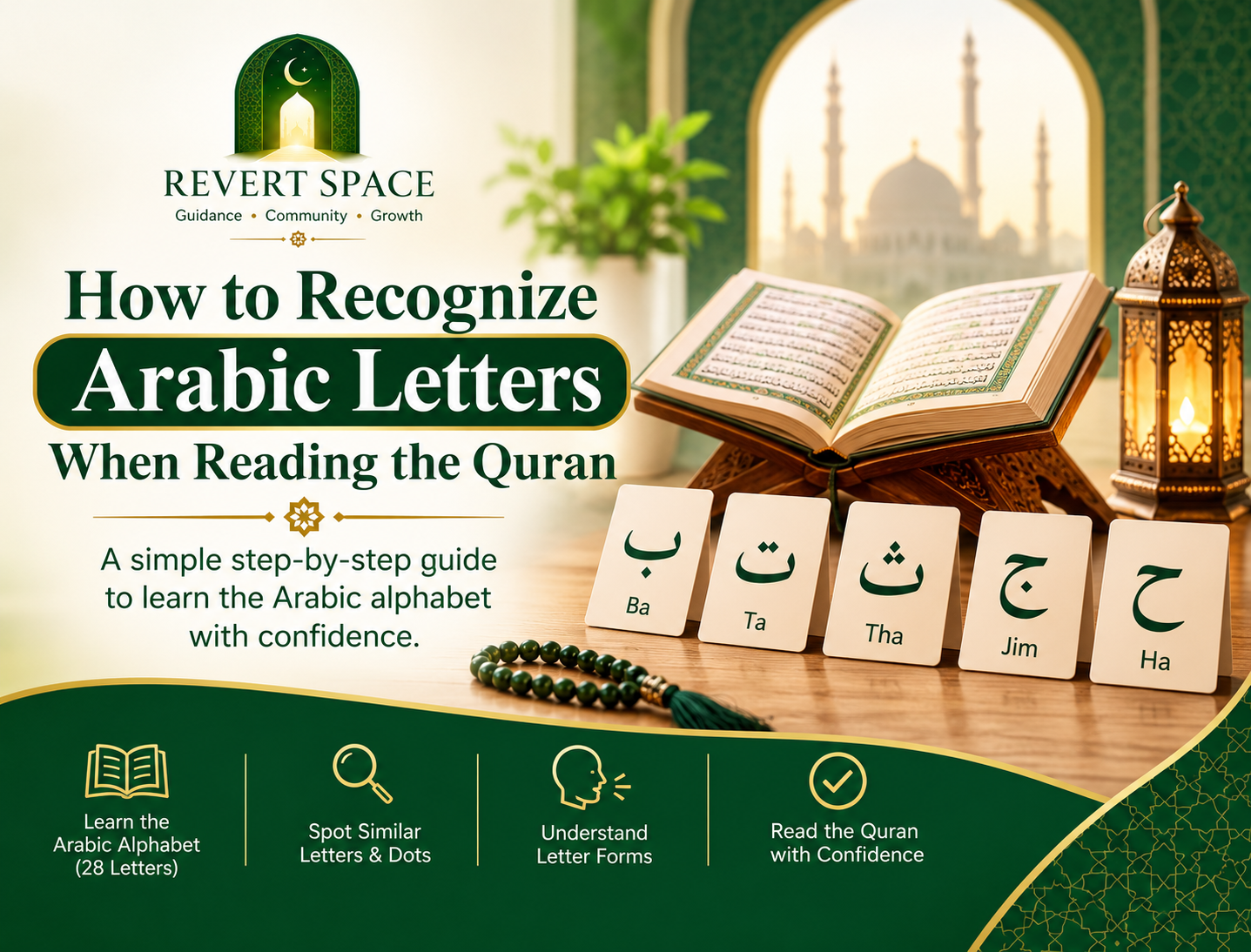
Your first look at a page of the Quran can feel like staring at beautiful patterns that refuse to turn into words.
Every reader goes through that stage, and recognition improves quickly once you know what to look for.
Beginner-friendly Arabic alphabet lessons for new Muslims teach those details in a clear order, so letters that once looked alike start to stand apart.
At Revert Space, we have supported more than 500 new Muslims, and one of the most common questions we hear is, “How do I tell these letters apart?” This guide explains the shapes, the dots, and the habits that make recognition easier, with a practice plan you can start today.
Start With the Big Picture
A few facts make the script far less intimidating:
- The Arabic alphabet has 28 letters
- Arabic is written and read from right to left
- There are no capital letters
- The letters stand for consonants, and three of them (alif, waw, and ya) also mark long vowel sounds
- Short vowels appear as small marks above or below the letters in the Quran
Many beginners expect hundreds of symbols. In reality, you need to learn 28 base shapes, their dots, and a handful of marks.
Why So Many Letters Look Alike
Many Arabic letters share one base shape and differ only by the number and position of their dots. Learning them in families helps your eye notice the difference:
- Ba, ta, tha, noon, and ya share a similar base. Ba has one dot below, ta has two above, tha has three above, noon has one above, and ya has two below.
- Jim, ha, and kha share a hook shape. Jim has one dot below, ha has none, and kha has one above.
- Dal and dhal share a shape, and dhal has a dot above.
- Ra and zay share a shape, and zay has a dot above.
- Sin and shin share a shape, and shin has three dots above.
- Sad and dad share a shape, and dad has a dot above.
- Ayn and ghayn share a shape, and ghayn has a dot above.
- Fa and qaf look alike, but fa has one dot above and qaf has two.
Studying these small groups is much easier than trying to memorize all 28 letters in a single list.
How Letters Change Shape
Most Arabic letters appear in up to four forms: alone, at the start of a word, in the middle, and at the end. The core shape stays recognisable, so look for the dots and the main curve.
Six letters connect to the letter before them but not to the one after them: alif, dal, dhal, ra, zay, and waw. This explains the small gaps you sometimes see inside a word. Knowing this saves beginners a lot of confusion, because a gap does not always mean a new word begins.
Short Vowels and Other Marks
The Quran includes marks that guide pronunciation. Start with these:
- Fatha, a small slash above a letter, gives an “a” sound
- Kasra, a small slash below a letter, gives an “i” sound
- Damma, a small curl above a letter, gives a “u” sound
- Sukoon, a small circle, shows that a letter has no vowel
- Shaddah, a small mark that looks like a tiny “w,” doubles the letter
- Tanween, doubled marks at the end of a word, adds an “n” sound
Some marks in the Quran are used for recitation and are less common in everyday Arabic. As your reading grows, a short guide to tajweed rules every Quran reading beginner should know will explain how these marks affect sound.
A Practical Way to Study the Letters
A clear routine prevents overwhelm. Try this order:
- Learn one letter family at a time, such as ba, ta, tha, noon, and ya
- Say each letter aloud and trace it by hand
- Practise each letter in all four positions
- Add the three short vowels to each letter you know
- Read simple three-letter words slowly
- Review old families before adding new ones
You can reinforce your learning with this list of Arabic words every new Muslim should learn first, which gives you real words to recognise as soon as you know a few letters.
Practise on a Real Quran Page
Textbook drills help, but the best practice happens on the page you will read in prayer. Start small:
- Choose a short surah and look for letters you already know
- Circle one family of letters, such as all the noons, and count them
- Follow the text with your finger while you listen to a clear reciter
- Compare the same word in different spots to see how shapes shift
Surah Al-Fatiha is a natural starting point because you recite it in every prayer. If you need more context, read what to learn about Salah first.
Many printed copies follow a standard layout of 604 pages, so the position of a verse on the page stays consistent across copies. That makes it easier to return to the same spot daily and notice progress.
Common Challenges and How to Handle Them
- Letters that look the same. Review one family at a time and write each letter by hand.
- Dots in the wrong place. Practise by covering the dots and then adding them back from memory.
- Reading right to left. Trace each line with your finger until your eyes adjust.
- New sounds. Letters like ع, ح, and ق have no equivalent in many languages, so practise slowly with a teacher.
- Gaps inside words. Remember the six letters that do not connect forward.
- Losing motivation. Set a weekly goal, such as reading one short surah with a friend.
Tips to Recognise Letters Faster
- Practise 10 to 15 minutes daily instead of one long session
- Use flashcards that show the letter on one side and its name and sound on the other
- Say the letter name and its sound together
- Record yourself reading and compare it with a skilled reciter
- Study with a partner. Read how to build community so you stay motivated and get feedback.
For a wider overview of the reading process, this guide shows how to learn Quran reading step by step. If you want a gentle introduction to the whole topic, read how to read the Quran for beginners.
How to Choose Reliable Teaching
Quality varies, so look for:
- Teachers with verifiable training
- A beginner order that starts with letter shapes and sounds
- Live feedback, since pronunciation needs a trained ear
- A welcoming tone with no pressure or shaming
The Qur’an Reading Program takes you from zero Arabic to confident reading, step by step. If you are still in your first weeks as a Muslim, the free Life After Shahada: First 30 Days Guide gives you a daily structure to follow.
An Expert Insight on Letter Recognition
In our experience at Revert Space, new Muslims who study letters in families and apply them to a short surah within the same week remember them far longer. Linking each new shape to a real word keeps the learning meaningful, and small daily practice beats long, rare sessions.
Frequently Asked Questions (FAQs)
1. How many letters are in the Arabic alphabet?
The Arabic alphabet has 28 letters. It is written from right to left and has no capital letters. Most beginners find it easier than expected, because many letters share a base shape and differ only by their dots.
2. How can beginners tell similar Arabic letters apart?
Learn the letters in small families that share a shape and differ by dots. For example, ba, ta, tha, noon, and ya share a base, and each has a different number or position of dots. Review one family at a time and write each letter by hand.
3. How can a beginner start recognising Arabic letters in the Quran?
Start with the letter names and sounds, then practise each letter in all its positions and add the short vowels. A beginner-friendly Arabic alphabet lessons for new Muslims path puts these steps in a clear order, so you do not have to guess what to study next.
4. Why do Arabic letters change shape?
Most Arabic letters have up to four forms: alone, at the start, in the middle, and at the end of a word. The core shape and dots stay recognisable. Six letters (alif, dal, dhal, ra, zay, and waw) do not connect to the letter after them, which creates small gaps inside words.
5. What do the small marks above and below Arabic letters mean?
They show vowels and pronunciation. Fatha gives an “a” sound, kasra gives an “i” sound, damma gives a “u” sound, sukoon shows no vowel, and shaddah doubles a letter. A short guide to tajweed rules every Quran reading beginner should know explains how these marks affect recitation.
6. How long does it take to learn the Arabic alphabet?
It varies, but many learners recognise most letters within a few weeks of regular practice. Ten to fifteen minutes a day works better than occasional long sessions. This guide on how to learn Quran reading step by step shows how to build that routine.
7. Can I learn to recognise Arabic letters online?
Yes. Online study fits around work and family and helps people far from a mosque. See how new Muslims learn from home, and pair lessons with a study partner or community so you get feedback on your reading.
8. What should I practise first on a real Quran page?
Start with a short surah and look for letters you already know. Surah Al-Fatiha is a natural choice because you recite it in every prayer, so read what to learn about Salah first. Build real vocabulary with this list of Arabic words every new Muslim should learn first.
9. Where can new Muslims get help learning to read the Quran?
Look for a clear beginner order, live feedback, and a welcoming community. The Qur’an Reading Program at Revert Space takes you from zero Arabic to confident reading, and the New Muslim Starter Program adds free mentorship and a judgment-free community.
Start Recognising Letters With Confidence
Arabic letters can look alike at first. With families, dots, and a few daily minutes of practice, they become familiar faster than most beginners expect. Learn in small groups, read real words, and ask a teacher to listen to you.
Revert Space offers free structured courses, 1-on-1 mentorship, and a judgment-free community for new Muslims. Join the New Muslim Starter Program and begin reading the Quran with people who understand your path.
