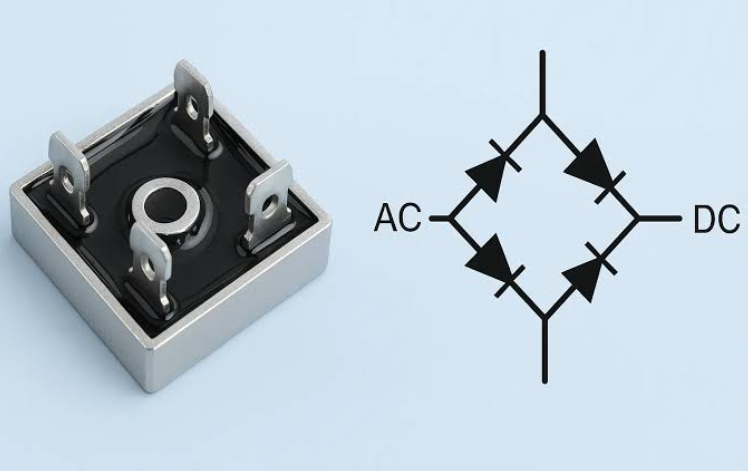
Converting alternating current (AC) to direct current (DC) is one of the most fundamental operations in modern power electronics. From basic wall adapters and consumer electronics to industrial motor drives and renewable energy inverters, virtually every electronic system relying on grid power requires an efficient rectification stage.
When designing an AC-DC conversion circuit, engineers frequently face a primary architectural decision: should you construct a discrete rectifier circuit using individual diodes, or opt for an integrated bridge rectifier package? While both approaches achieve the same functional goal, the choice significantly impacts circuit size, thermal management, manufacturing complexity, and overall system cost.
Understanding the Fundamentals of AC-DC Rectification
At its core, rectification involves allowing current to flow in only one direction, effectively blocking the negative half-cycles of an AC sine wave or steering them into a single polarity.
Half-Wave vs. Full-Wave Rectification
Using a single diode results in half-wave rectification. While simple, this method only utilizes half of the incoming AC waveform, leading to low power efficiency, high ripple voltage, and a heavy filtering burden on output capacitors.
Full-wave rectification, on the other hand, converts both the positive and negative halves of the AC cycle into a single DC output polarity. This dramatically improves energy utilization, reduces output ripple, and makes downstream smoothing much easier. Full-wave conversion is typically achieved in two ways:
- Using a center-tapped transformer with two discrete diodes.
- Using a four-diode topology (a Graetz bridge) connected across a standard single-phase AC source.
Selecting high-quality discrete power rectifiers allows designers to optimize parameters like forward voltage drop (VF), reverse recovery time (trr), and surge current handling (IFSM) for tailored rectification stages.
Individual Diodes: Flexibility and High-Frequency Performance
Building a rectifier stage out of discrete diodes offers maximum layout flexibility and specialized electrical characteristics that integrated packages sometimes struggle to match.
Key Advantages of Discrete Diodes
- Custom Topology Selection: Discrete diodes allow engineers to build specific configurations beyond basic single-phase bridges, such as multi-phase rectifiers, voltage multipliers, or custom power factor correction (PFC) circuits.
- Optimal Thermal Spacing: Spreading four separate diodes across a printed circuit board (PCB) distributes heat generation over a larger surface area. This prevents localized hot spots, making thermal management easier in naturally convection-cooled enclosures.
- High-Frequency Optimization: In high-frequency switch-mode power supplies (SMPS), standard bridge rectifiers may introduce excessive switching losses. Using individual Schottky barrier diodes or ultra-fast recovery diodes ensures minimal trr and higher efficiency at switching frequencies well above 100 kHz.
Trade-offs
The primary downside of discrete diodes is board footprint and component count. Placing four individual devices increases pick-and-place assembly time, requires more PCB trace routing, and raises the risk of parasitic inductance if layout traces are not carefully balanced.
Bridge Rectifiers: Integration and Compact Efficiency
An integrated bridge rectifier combines four (or six, for three-phase systems) diode dies into a single, factory-tested package. This arrangement simplifies primary AC-to-DC conversion for standard mains power supplies.
For engineers seeking pre-packaged solutions across various voltage and current ratings, exploring dedicated bridge rectifiers provides a streamlined path to selecting compact, high-density components.
Key Advantages of Integrated Bridge Rectifiers
- Compact PCB Footprint: Consolidating four diodes into a single package (such as ABS, DB, KBP, or GBJ inline profiles) saves valuable board space, making them ideal for high-density power adapters and compact consumer devices.
- Simplified Heat Sinking: High-power applications generating significant thermal losses benefit from a single mounting surface. A bridge rectifier housed in a metal-clad or through-hole package (like a TO-247 or GBJ format) can be directly attached to a single shared heatsink.
- Reduced Design Complexity: Using a single pre-matched component simplifies schematic capture, reduces bill-of-materials (BOM) management, and speeds up automated PCB assembly.
Trade-offs
Because four silicon dies are packed tightly together within a single epoxy encapsulation, heat is highly concentrated. If the component operates near its maximum current limits without adequate thermal copper planes or external cooling, junction temperatures can rise rapidly.
Comparing Discrete Diodes vs. Bridge Rectifiers
To choose the right option for your design, consider how the two approaches compare across core engineering metrics:
| Parameter | Discrete Diode Array | Integrated Bridge Rectifier |
| Board Area | Larger overall PCB footprint | Compact, high-density layout |
| Component Count | 4 individual components | 1 integrated package |
| Thermal Distribution | Heat is spread across the PCB | Heat is concentrated in one spot |
| Heatsink Mounting | Requires multiple heatsinks/pads | Simple attachment to a single heatsink |
| High-Frequency Performance | Excellent (wide Schottky/Fast-Recovery selection) | Best suited for low-to-medium frequencies (50/60 Hz mains) |
| Assembly & BOM Cost | Higher pick-and-place count | Lower assembly complexity |
Application-Specific Selection Guide
When to Choose Discrete Diodes
- High-Frequency SMPS Secondary Stages: When rectifying high-frequency AC outputs from a switching transformer, fast recovery or Schottky discrete diodes are necessary to prevent thermal breakdown caused by switching losses.
- Ultra-Low Profile Designs: In thin electronics where vertical component height is restricted, placing low-profile surface-mount discrete diodes (like SMA or SMB packages) is often easier than fitting a taller bridge module.
- Distributed Thermal Constraints: When an enclosure lacks forced air cooling and cannot accommodate a vertical heatsink, spreading thermal dissipation across multiple discrete PCB copper pads prevents single-point overheating.
When to Choose an Integrated Bridge Rectifier
- Standard AC Mains Entry (50/60 Hz): For direct line-voltage rectification (110V/230V AC) entering a power supply, standard bridge modules provide reliable performance with minimal design effort.
- High-Current Industrial Power Stages: When dealing with load currents exceeding 10A, mounting a single inline bridge package to a chassis or extruded aluminum heatsink is far more practical than cooling four separate high-power discrete packages.
- Space-Constrained Consumer Goods: Wall chargers, LED drivers, and small home appliances rely on compact surface-mount bridge rectifiers to minimize total product size.
Design Best Practices for Rectifier Stages
Regardless of which architecture you choose, implementing a few key design principles will ensure long-term stability and reliability:
- Account for Surge Currents (IFSM): At power-on, bulk input capacitors act as near-short circuits, drawing heavy inrush current. Ensure your chosen diodes or bridge rectifier can handle peak non-repetitive surge ratings without degrading.
- Derate Thermal Specifications: Silicon junction temperatures should ideally be kept below 125°C during peak operating ambient conditions. Always calculate thermal resistance (RJA or RJC) and provide adequate PCB copper pours or heatsinking.
- Voltage Margin Selection: For standard mains applications, choose components with a reverse breakdown voltage (VRRM) rating at least 2 to 3 times higher than the peak AC voltage to protect against utility grid voltage transients and inductive ringing.
See also: How Process Mining Reveals Business Insights
Final Thoughts
Deciding between discrete diodes and an integrated bridge rectifier ultimately comes down to balancing frequency requirements, spatial constraints, and thermal management strategies. Discrete power rectifiers provide unmatched flexibility, superior thermal spreading, and optimized performance for high-frequency switching applications. Conversely, integrated bridge rectifiers streamline design workflows, drastically reduce PCB footprint, and offer straightforward heat sinking for line-frequency AC-DC conversion. By carefully evaluating operating frequencies, peak current demands, and mechanical package limits early in the design cycle, engineers can build highly efficient, reliable power conversion stages tailored to their specific application needs.
