A protective coating looks deceptively simple. It is a thin layer of paint, powder, or specialised material spread over metal, often no thicker than a sheet of paper. Yet on an aircraft component, a turbine part, or a precision-manufactured bracket, that thin layer is frequently the only barrier between the metal underneath and corrosion, heat, moisture, and wear. When it holds, nobody notices it. When it fails, the consequences can range from expensive repairs to a genuine safety risk.
The difficulty is that coatings rarely fail on the day they are applied. They fail after months or years of repeated stress: vibration in flight, thermal expansion and contraction, flexing under load, and countless small cycles that slowly work cracks into the surface. Understanding that slow process, and proving a coating can survive it, is exactly what coating fatigue testing is for.
The Hidden Weakness in a Shiny New Component
A freshly coated part can pass a visual inspection and still carry the seeds of failure. Under repeated cyclic loading, microscopic cracks can form at points where the coating and the metal expand at different rates, or where the surface flexes the most. Those cracks are pathways. Moisture and salts slip through them, corrosion starts beneath the coating, and adhesion is gradually lost from the inside out. By the time blistering or flaking becomes visible, the damage underneath is often well advanced.
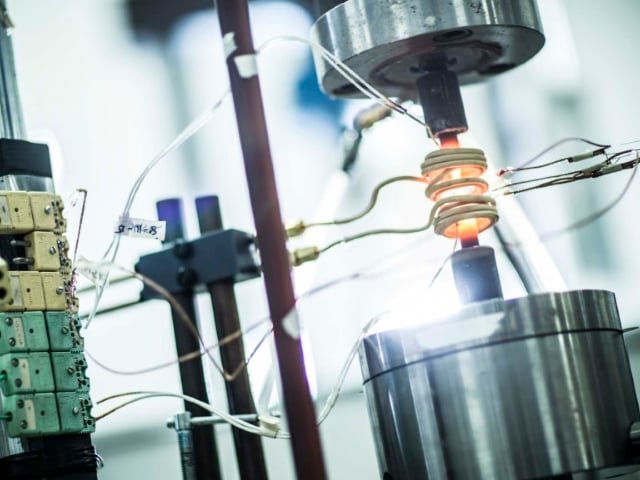
In aerospace, that sequence matters enormously. Components are expected to perform reliably for decades, through take-offs, landings, pressurisation cycles, and constant vibration. Manufacturers cannot simply hope a coating will last that long. They need evidence, gathered under controlled conditions that compress years of service into a test programme. This is why Mechanical testing focused on coating fatigue has become a standard part of qualification for safety-critical parts, rather than an optional extra.
What a Fatigue Test Actually Reveals
A laboratory programme does far more than bend a sample until something breaks. Test pieces are subjected to repeated loading cycles that mimic real service conditions, sometimes running into hundreds of thousands or millions of cycles. Alongside the mechanical stress, samples may face humidity, salt spray, temperature swings, and ultraviolet exposure, because in the real world these forces never arrive one at a time.
Engineers then examine how the coating responds. Where do cracks first appear? How quickly do they spread? Does the coating stay bonded to the substrate, or does it begin to lift at the edges of a crack? Adhesion tests, cross-section analysis, and careful visual grading turn those questions into measurable results. The value lies in the comparison: two coating systems that look identical on day one can behave very differently after simulated years of use, and testing is what exposes that difference before a part enters service.
Just as importantly, testing can identify whether a failure begins in the coating itself, in the surface preparation, or in the application process. A weak link in pretreatment, for example, may show up as early delamination under cyclic stress, prompting a process fix long before parts reach an aircraft or a production line.
Quality That Can Be Proved, Not Just Promised
For manufacturers, this evidence underpins quality in a very practical way. Airframers, engine makers, and their suppliers work within strict specifications and audit regimes. A documented test result shows that a chosen coating system, applied by a defined process, meets a defined durability requirement. That traceability protects everyone in the chain, from the coater to the final operator.
It also improves decision-making. If a test shows a coating cracking earlier than expected, engineers can change the material, adjust the thickness, improve surface preparation, or redesign a stress point while the component is still on the drawing board or in pilot production. Every one of those changes is far cheaper, and far safer, than discovering the same weakness during maintenance inspections years later.
Coating fatigue testing is therefore best understood as a safety discipline disguised as a laboratory routine. The rigs, cycles, and reports may look unglamorous, but they answer a question on which lives and livelihoods can depend: will this protective layer still be doing its job after the ten-thousandth cycle, not just the first? For aerospace and advanced manufacturing, only a tested answer is good enough.
