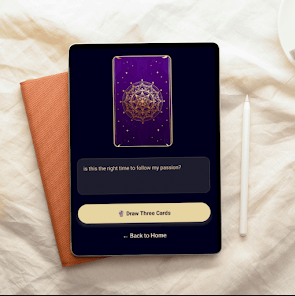
You’ve probably tried a tarot app. You pick three cards, tap through a sleek interface, and get a reading about “new beginnings” and “creative energy” — words that could apply to anyone, anywhere. The card art is beautiful. The interpretation? Something you could have read in a newspaper horoscope.
Most tarot apps are built on templates: fixed paragraphs assigned to each card, stitched together with a little randomization. They don’t know your question, your circumstances, or how the cards might speak to each other. Conversational AI can now generate readings that respond to who you are and what you’re actually asking — and the difference is worth understanding.
The Problem With Template-Based Tarot Apps
Most tarot apps work like a deck of index cards. The Tower appears? Here’s the Tower paragraph. The app may shuffle the order or add a decorative border, but the content was written once and never changes.
This creates three predictable problems. First, the reading ignores your question — asking about a career change and asking about a new relationship can produce eerily similar text. Second, cards are read in isolation, though a card’s meaning shifts depending on its neighbors: the Sun next to the Three of Swords tells a very different story than the Sun next to the Ten of Cups. Template apps rarely model these relationships. Third, there’s no follow-up: you can’t ask, “What did you mean by that?” The app delivers its verdict and moves on.
The result is a reading that feels technically correct but emotionally flat — advice from someone who never learned your name.
How Contextual Interpretation Changes the Reading
An AI tarot reading built on a language model works differently. Instead of pulling pre-written paragraphs from a database, it generates an interpretation in real time, shaped by your question, the spread, each card’s position, and the context you’ve shared.
Consider a Past–Present–Future pull producing the Eight of Pentacles, the Hanged Man, and the Ace of Wands. A template app gives you three standalone meanings: hard work, surrender, new inspiration. A contextual reading weaves them into a narrative: years of disciplined effort (Eight of Pentacles) have brought you to a point where striving harder isn’t the answer (Hanged Man), and the breakthrough will come from a shift in perspective that unlocks fresh creative direction (Ace of Wands). The cards don’t just sit side by side — they argue with each other, and the interpretation follows the argument.
The difference is even sharper with positional spreads like the Celtic Cross. The Five of Pentacles in the “hopes and fears” position says something entirely different from the same card in “the outcome.” A contextual reader interprets the card through its position; a template app rarely adjusts for that.
Personalization Beyond the Question
It maps cards onto your real situation
Tell it you’re choosing between two job offers — one stable, one risky — and it can map specific cards onto those actual options. The reading stops being about “career energy in general” and starts being about your decision.
It explains itself
Confused about why the Devil appeared in a reading about your creative project? You can ask. A conversational reader will unpack the symbolism — attachment, obsession, the shadow side of ambition — and connect it to what you’ve shared. This dialogue turns a one-way broadcast into something closer to a session with a thoughtful human reader.
It asks clarifying questions
A good human reader often begins with questions: “What do you really want to know here?” An AI reader can do the same, refining a vague prompt (“tell me about my future”) into something specific enough to produce a meaningful spread. That back-and-forth is where personalization actually lives — in the narrowing of attention.
What “More Personal” Does and Doesn’t Mean
A more personal reading doesn’t mean a more accurate one. Tarot is a reflective tool, not a prediction engine, and no amount of contextual sophistication changes that. What AI personalization offers is resonance: a reading connected to your circumstances gives you something real to reflect on.
There are things AI can’t replicate. A skilled human reader picks up on tone and hesitation, improvises, and knows when to push and when to stay quiet. An AI reader works from what you’ve typed — it can be insightful, but it can’t truly know you. The personalized tarot interpretation it produces is only as rich as the context you give it.
Privacy matters too. The more personal a reading becomes, the more you’re sharing about your life. Use services you trust, and think twice before typing your most sensitive details into any platform.
Getting the Most From an AI Tarot Reading
The quality of your input matters enormously:
Ask a real question. “Will I be happy?” is too broad. “Should I take the freelance contract or stay in my salaried role?” gives the reading something to work with. Specificity in, specificity out.
Provide context. A few sentences about your situation transform the output — the reader can’t weave them in otherwise.
Choose a spread with intent. A single card is fine for daily reflection. For a genuine decision, use a positional spread so the AI has structure to interpret through.
Treat it as a conversation. If something doesn’t land, say so. Ask follow-up questions. The iterative back-and-forth is where the personal dimension deepens.
Reflect, don’t outsource. The best use of a tarot reading is as a mirror rather than a map — if it surfaces a perspective you hadn’t considered, that’s the win.
Conclusion
Template-based tarot apps gave us beautiful cards and hollow readings. They democratized the ritual of tarot without delivering the substance — the sense that these particular cards are speaking to this particular moment in your life.
Contextual AI interpretation closes much of that gap. By weaving your question, your circumstances, and the relationships between cards into a single narrative — and by letting you question, refine, and deepen it in conversation — it produces something that feels genuinely one-to-one. It won’t replace the intuition of a gifted human reader, and it shouldn’t replace your own judgment. But compared to the template app on your phone, it’s a fundamentally different experience: less fortune cookie, more conversation.
