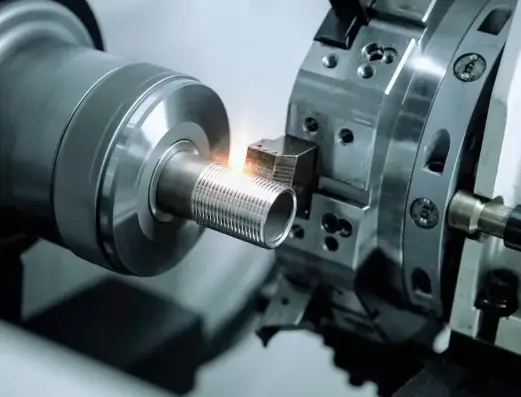
When reading the specification sheets for high-end machining tools, you often encounter claims of micron-level precision. Measurements like 0.005mm (5 microns) sound impressive on paper, but what do they mean in a practical workshop environment?
For hobbyists, engineers, and small-batch manufacturers, understanding tolerances is the difference between a prototype that fits together seamlessly and one that binds, wobbles, or fails under load.
In this article, we will break down the physical reality of 0.005mm turning accuracy, how it compares to everyday objects, why it matters for mechanical projects, and how modern hardware makes this level of precision attainable at home.
Visualizing 0.005 Millimeters: Scale & Context
To grasp just how small 0.005mm is, it helps to compare it to objects we interact with every day:
- Human Hair: An average strand of human hair is roughly 0.07mm (70 microns) thick. A 0.005mm tolerance is 14 times thinner than a single hair.
- Red Blood Cell: A single red blood cell is about 0.007mm to 0.008mm across.
- Standard Copy Paper: A standard sheet of printer paper is about 0.10mm (100 microns) thick—equivalent to 20 layers of 0.005mm increments.
When a lathe achieves 0.005mm dimensional accuracy, it means the variance between the target diameter and the finished physical part is smaller than microscopic biological cells.
Why Does 0.005mm Turning Accuracy Matter?
In basic woodworking or coarse crafting, a variance of 0.5mm is easily manageable. However, in rotational motion, fluid dynamics, and high-speed assemblies, sub-hundredth-millimeter variances dictate whether an assembly works or fails.
1. True Interference and Press Fits
When mounting bearing races, bushings, or motor couplings onto a shaft, you rely on exact fit classes. A press-fit (where a shaft is slightly larger than the hole it presses into) requires tolerances within 0.005mm to 0.01mm.
If your shaft is 0.02mm too large, you will crack the bearing casing during installation. If it is 0.02mm too small, the bearing will slip, causing unwanted heat and vibration.
2. Eliminating Runout (Concentricity)
In high-speed spindle shafts or custom rotational axles, even slight off-center variance creates severe vibration (runout). Achieving exceptional precision CNC turning guarantees that the rotational center aligns perfectly across the length of the workpiece, extending the lifespan of motor bearings and mechanical drives.
3. Interchangeability in Small-Batch Production
If you manufacture custom mechanical upgrades, RC car components, or custom brass fittings, your customers expect replacement parts to match the original specifications exactly. Tight tolerances ensure that part #1 and part #100 fit identically into an assembly without custom hand-filing.
Precision Benchmarks Across Workshop Tools
To understand where high-precision turning sits in the broader manufacturing landscape, consider these common workshop tolerances:
| Fabrication Tool / Process | Typical Real-World Tolerance | Primary Use Case |
| FDM 3D Printing | 0.10mm to 0.20mm | Rapid plastic prototyping, enclosures |
| Standard Desktop CNC Router | 0.05mm to 0.10mm | Wood carves, sheet cutting, acrylic signs |
| Diode / CO2 Laser Cutter | 0.03mm to 0.08mm | Sheet cutting, surface engraving |
| Standard Metal Lathe | 0.01mm to 0.03mm | Manual turning, basic metal shafts |
| High-Precision CNC Lathe | 0.005mm ($5\ \mu\text{m}$) | Bearing fits, medical parts, micro-hydraulics |
Key Factors Required to Maintain 0.005mm Accuracy
Achieving 5-micron tolerances is not just about the stepper motors; it requires control over the entire machining system:
1. Structural Rigidity
Cutting forces exert significant pushback against the cutting tool. If the machine body flexes even a fraction of a millimeter under load, 0.005mm precision is lost instantly. Heavy cast frames, linear guide rails, and pre-loaded ball screws are essential to resist mechanical deflection.
2. Thermal Expansion Control
Metals expand when heated. For example, aluminum expands by roughly 0.023mm per meter for every 1°C increase in temperature. On a small steel workpiece, a temperature shift of just 5°C during aggressive cutting can alter dimensions beyond the 0.005mm limit. Proper lubrication, coolants, and sharp cutting inserts keep thermal expansion under control.
3. Tool Wear and Lead Screw Quality
At 0.005mm, even subtle wear on a carbide insert tip shifts the cutting plane. Using high-grade ground ball screws rather than standard lead screws ensures smooth motion with zero backlash.
The Evolution of Home Fabrication
A decade ago, holding 5-micron tolerances required industrial-grade, room-sized turning centers costing tens of thousands of dollars. Today, advances in motion control, rigid frame engineering, and accessible automation have brought high-precision machining straight to home workshops.
By incorporating high-rigidity tools into modern desktop fabrication setups, makers can design, turn, and finish high-tolerance metal hardware directly on their workbench.
Conclusion: Is 0.005mm Precision Necessary for Your Project?
While not every DIY project demands 5-micron accuracy, having access to this level of precision opens up advanced engineering capabilities:
- Go for 0.005mm accuracy if: You build high-RPM spindles, press-fit bearing assemblies, micro-fluidic valves, optical housings, or custom watch/horology parts.
- Standard tolerances (0.05mm) are sufficient if: You are machining decorative pieces, basic spacers, structural brackets, or non-interlocking wood and plastic shapes.
Understanding how tolerances translate to physical fit allows you to design better hardware, select the right tools for your workshop, and push the boundaries of what you can build at home.
