
It is the night before moving day, the cabinets are still full, and the last few sheets of packing paper are gone. Don’t panic. Here is how to pack dishes without packing paper: wrap each piece in a soft household item like a dish towel, stand plates on their edge in a small, sturdy box, and fill every gap so nothing can shift.
Packing paper is handy, but it is not magic. What protects a plate is cushioning, a snug fit, and the right position in the box. Towels, linens, and clothes can handle the first two jobs, and a few simple rules cover the third. This guide covers what to use, how to wrap each type of dish, and the mistakes that cause most breakage.
How to Pack Dishes Without Packing Paper: The Three Core Rules
Three rules do most of the work: cushion every piece, stand plates on edge, and leave no empty space in the box. If you follow only these, your dishes will travel better than a box of loosely wrapped plates ever could.
Cushioning means nothing hard touches anything else. Every plate, bowl, and glass gets a soft layer around it, and the box gets a soft layer on the bottom and the top. Standing plates on edge keeps the weight of the load running along the strongest part of each plate. And filling gaps stops the contents from sliding and knocking together on turns and bumps.
Everything else in this guide is a detail on those three ideas. That is good news, because it means the materials matter less than the method.
What to Use Instead of Packing Paper
Any clean, soft, fairly thick item you already own can stand in for paper. Raid the linen closet and the laundry basket before you buy anything.
- Dish towels and hand towels: the best all-round wrap for plates and bowls. They are thick, washable, and already in the kitchen.
- Bath towels and small blankets: line the bottom and top of each box, and wrap large platters.
- Cloth napkins and pillowcases: good for wrapping single pieces and for slipping between bundled plates.
- T-shirts and sweaters: a soft wrap for glasses and mugs. Skip anything with zippers, hard buttons, or sharp trim, which can scratch glazed surfaces.
- Clean socks: pull one over a glass, or tuck one inside a mug to cushion the hollow space.
- Paper towels: a thin layer between nested bowls, though not enough on their own for plates.
One caution about newspaper. Plain newsprint can leave ink smudges on dishes, so if you have a pile of it, use it as filler for gaps rather than as the wrap that touches the dish.
There is a bonus to using linens: you pack two things at once, and you may need fewer boxes for towels later. The trade-off is that fabric takes up more room than paper, so expect to use a few more boxes for the dishes themselves.
Choose a Small, Sturdy Box (a Dish Pack Box Is Ideal)
Pick a small box with strong walls, because plates are heavy and a large box invites overfilling. A dish pack box is a thick, double-walled carton, often sold with dividers, that is made for dishes and glassware. If you can get one, it is the best choice. If not, a small, new, double-walled moving box works well.
Tape the bottom seam across the middle and along both edges, then add a thick layer of folded towels before any dishes go in. Keep each box light enough that you can lift it comfortably. A box that is too heavy for you is also too heavy for the bottom cardboard to carry for long.
Before you pack, sort through the cabinets. The home improvement retailer Home Depot suggests in its dish packing guide that a move is a good time to set aside chipped or pitted glassware and to use towels and lighter kitchen items to fill empty space instead of packing every box to the top with dishes. That advice saves both weight and breakage.
How to Pack Plates Vertically, Step by Step
To pack plates vertically, wrap each plate in a towel, bundle two or three together, and stand the bundles on their edge like records in a crate. Here is the full process.
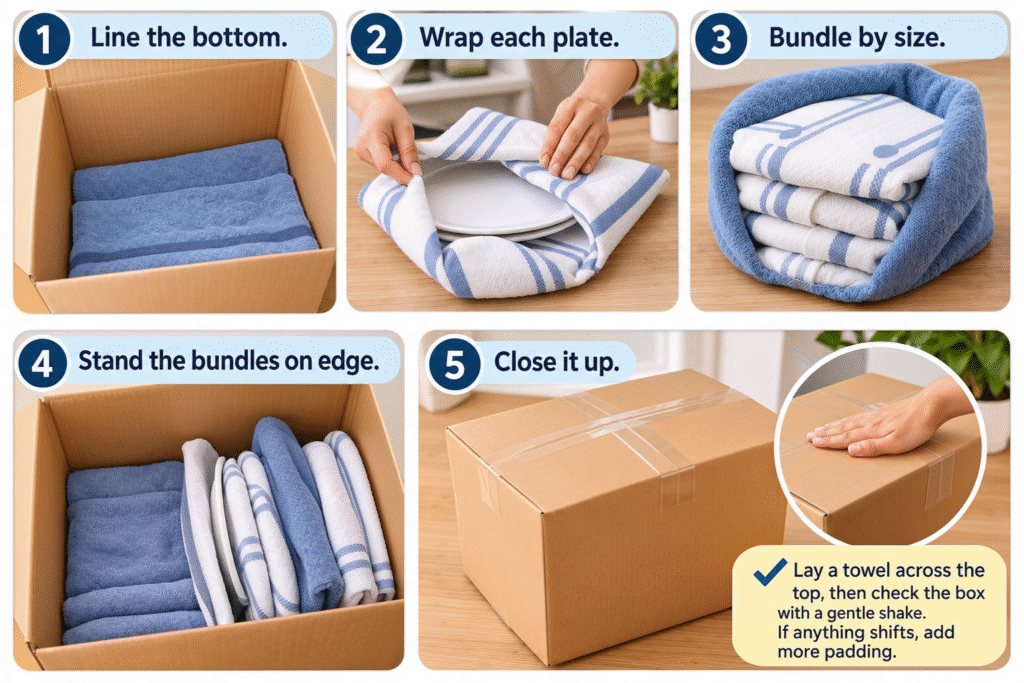
Why on edge? A plate is strongest along its rim. Stood up, it takes pressure along that rim. Stacked flat, each plate has to carry the weight of every plate above it, which is how a full stack cracks from the bottom.
Packing Bowls, Mugs, and Glasses for a Move
Hollow items need padding inside as well as outside. A bowl or mug that is wrapped only on the outside can still crack if the inside is open and something presses on the rim.
Bowls
Wrap each one individually in a towel or napkin. Shallow bowls can stand on edge like plates. Deeper bowls can nest, but only with a layer of cloth between each one, and they should sit rim-down or sideways with cushioning on all sides.
Mugs
Tuck a sock or small cloth inside, wrap the outside, and pay extra attention to the handle, since handles snap first. Stand mugs upright or lay them on their sides with padding between them.
Glasses and stemware
Stuff a clean sock or soft cloth inside each glass, then wrap the whole thing in a T-shirt or towel. Pack stemware with extra padding around the stem, which is the weakest point. Glasses should go near the top of the box, upright, with the heavier plates and bowls underneath.
The rule for packing glasses for a move is simple: nothing hard should be able to touch the glass from any direction, including from the inside.
See also: How Process Mining Reveals Business Insights
Using Towels as Padding When Moving: Fill Every Gap
Towels as padding when moving work best as gap fillers, because empty space is what lets dishes build up speed and hit each other. Once your wrapped dishes are in the box, look at the corners, the sides, and the top. Anywhere you can see a hole, push in a rolled dish towel, a sock, or a folded napkin.
Then run the shake test. Close the flaps, tilt the box gently from side to side, and listen. Any clinking or feeling of movement means the contents are loose and need more padding. It takes ten seconds and catches the most common problem.
Finish by sealing the box and labeling it on the top and at least two sides: “Fragile,” “This side up,” and “Kitchen.” A clear label helps whoever carries it know to keep it level and to keep heavy boxes off the top.
Common Mistakes That Break Dishes
Most breakage comes from a short list of avoidable mistakes.
- Stacking plates flat. The weight builds up on the lowest plate.
- Using an oversized box. It gets too heavy, the bottom gives out, or the dishes shift inside.
- Leaving gaps. Loose space is where chips and cracks begin.
- Wrapping with hard-edged fabric. Zippers and buttons can scratch glaze.
- Mixing weights carelessly. Put heavy plates and platters at the bottom, light glasses and cups on top.
- Skipping the label. An unmarked box gets stacked under something heavy.
When It Makes Sense to Hand Off the Packing
Doing it yourself saves money, but it is not always the smartest choice. The U.S. Department of Transportation’s Federal Motor Carrier Safety Administration explains that for interstate moves, the free Released Value option covers no more than 60 cents per pound per article, so a heavy box of china would pay out very little if it were damaged. The agency also warns that if you pack your own boxes and something inside breaks, it can be harder to establish a claim against the mover. The federal rules cover interstate moves, and rules for moves within a state vary, so check what applies to you.
That does not mean you should avoid packing your own dishes. It does mean the pieces you care about most deserve a plan. For heirloom china, a long-distance move, or a tight schedule, professional packing services can take on just the fragile boxes while you handle the rest, as one option for sharing the work.
If you pack everything yourself, take photos of valuable sets before they go in the box. Photos make it easier to describe what was inside if something is damaged later.
Frequently Asked Questions
Can I pack dishes with towels instead of packing paper?
Yes. Clean dish towels, bath towels, and cloth napkins make excellent wrapping and padding, and they are often thicker than paper. Wrap each dish individually, bundle plates in twos or threes, and fill every gap. Expect to use a few extra boxes, since fabric takes up more room than paper.
Is it better to pack plates vertically or flat?
Vertically. Plates stood on edge take pressure along the strongest part of the rim, while plates stacked flat make each lower plate carry the weight of the ones above it. Wrap each plate, bundle two or three, and stand them in a tight row with padding on every side.
What can I use to wrap glasses if I have no bubble wrap?
Use clean socks, T-shirts, and dish towels. Stuff a sock or small cloth inside each glass so the hollow is supported, then wrap the outside in a soft fabric. Place wrapped glasses upright near the top of the box, with plenty of padding around and between them.
Do I need a dish pack box?
No, but it helps. A dish pack box is a thick, double-walled carton, often with dividers, built for the weight of dishes. If you cannot get one, use a small, new, sturdy box, tape the bottom well, and add a thick towel layer at the base. Avoid large, thin boxes.
How do I know if a box of dishes is packed tightly enough?
Do the shake test. Close the flaps and tilt the box gently from side to side. If you hear clinking or feel items sliding, open it and add rolled towels or socks to the gaps. A well-packed box feels solid and makes almost no noise when you move it.
Pack Smart With What You Have
Missing packing paper is a small problem, not a packing disaster. A towel does the same cushioning job, a small sturdy box does the carrying, and a tight fit does the rest. Get those three right and your dishes can arrive in one piece.
Before you tape the last box shut, give it one more shake, add one more rolled towel if anything moves, and mark the top so it stays upright. That small bit of care is what keeps dinner plates intact at the other end.
